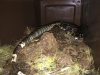
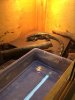
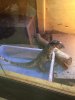
In August of 2015 I was contacted about possibly taking in a 3 year old tegu - the catch was I had to take him as soon as possible because his brother/roommate had started picking on him and his owners didn't have space for another large enclosure. So I immediately set out to design an enclosure that could work for at least a year.
Notes:
- The build started Aug 29, and Scaley Puppy moved in on October 3 - so it took just over a month to complete.
- The location my animals are currently at does not have a ton of space, so I was limited in the size of enclosure I could build. He was previously living in a shared 6'x3' enclosure, so that was the size I decided to use (when I move the plan is for him to have at least a half-room walk-in enclosure).
- The tegu ended up being a Columbian instead of an Argentinian, which worked out in my favour size-wise. I feel like this would be quite small for an adult Argentinian, even for a temporary enclosure.
- Because I don't intend this tank to last for too long I used cheap materials (2x4s and 1/2" plywood).
- The tank is designed to be bio-active (and it definitely is) and was originally planted with grass, but that all died very quickly once the tegu moved in.
- Since move-in day I have had to seal off all the vents (there is still gaps at the doors) to hold humidity. I also had to unplug 3 of the 4 spot lights.
Design in AutoCAD (this may not make sense to anyone, but I basically planned it all down to where I would put the screws - even so some things were not correct in the plans and had to be adjusted):

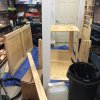
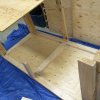
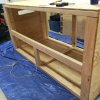
The build:
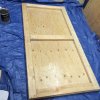
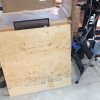
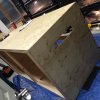
Some of my helpers showing off the size of this tank:


Sealing/Staining/Lights:
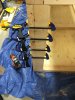
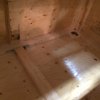
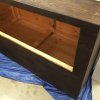
- The inside is sealed with many, many, many coats of outdoor varathane, and all the edges are siliconed. Sealing was the most labour-intensive and time-consuming part of this build. We literally sealed each piece of wood before the build, poured the varathane onto the individual pieces (top/bottom/sides) and leave it to dry for a day, then put the pieces together and varathane it again, then seal the corners with silicone, then varathane it again. The inside has 4-7 coats of varathane, the outside has 1-2 coats.
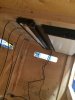
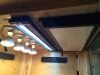
- There is a large radient heat panel on 24/7 (but on a rheostat, so it shuts off it the temp goes above 120), a 10.0 UVB tube, two reptile basking spot lights and two garden store floor lights.
Apparently there's a photo limit, so I'll continue in the next post.
Notes:
- The build started Aug 29, and Scaley Puppy moved in on October 3 - so it took just over a month to complete.
- The location my animals are currently at does not have a ton of space, so I was limited in the size of enclosure I could build. He was previously living in a shared 6'x3' enclosure, so that was the size I decided to use (when I move the plan is for him to have at least a half-room walk-in enclosure).
- The tegu ended up being a Columbian instead of an Argentinian, which worked out in my favour size-wise. I feel like this would be quite small for an adult Argentinian, even for a temporary enclosure.
- Because I don't intend this tank to last for too long I used cheap materials (2x4s and 1/2" plywood).
- The tank is designed to be bio-active (and it definitely is) and was originally planted with grass, but that all died very quickly once the tegu moved in.
- Since move-in day I have had to seal off all the vents (there is still gaps at the doors) to hold humidity. I also had to unplug 3 of the 4 spot lights.
Design in AutoCAD (this may not make sense to anyone, but I basically planned it all down to where I would put the screws - even so some things were not correct in the plans and had to be adjusted):
The build:
Some of my helpers showing off the size of this tank:
Sealing/Staining/Lights:
- The inside is sealed with many, many, many coats of outdoor varathane, and all the edges are siliconed. Sealing was the most labour-intensive and time-consuming part of this build. We literally sealed each piece of wood before the build, poured the varathane onto the individual pieces (top/bottom/sides) and leave it to dry for a day, then put the pieces together and varathane it again, then seal the corners with silicone, then varathane it again. The inside has 4-7 coats of varathane, the outside has 1-2 coats.
- There is a large radient heat panel on 24/7 (but on a rheostat, so it shuts off it the temp goes above 120), a 10.0 UVB tube, two reptile basking spot lights and two garden store floor lights.
Apparently there's a photo limit, so I'll continue in the next post.